

Greg Rentsch, COO | March 10, 2026 |
- Developing Leaders
Leadership in the age of reinvention: What really motivates growth at each level
Work is being reshaped at every level. AI is removing repetitive tasks while increasing the demand for sharper judgment and stronger decision-making. Hybrid work and shifting workflows add complexity that many leaders were not trained for. Success depends on whether a leader’s motivations match what their role truly requires.
Across more than 10,000 assessments, PRADCO’s Quick View™ Leadership (QVL) data reveals a consistent pattern: Improvement fuels growth for Individual Contributors, while Ownership drives performance for Managers and Executives. As expectations evolve, this motivation fit becomes essential to developing leaders who can deliver in a faster, more adaptive environment.
This article explains how to identify that fit and how to support leaders at each level as responsibilities and motivations shift.
Why Motivation Matters More This Year
AI adoption and workflow redesign mean more work is being handled in partnership with intelligent agents and automated systems. As roles evolve, leaders must continuously rebalance learning and accountability to keep execution reliable and adaptive. That’s why the right motivation mix by level matters more now than it did even a few years ago.
Performance research continues to affirm that growth requires the right amount of stretch. Too little challenge leads to stagnation; too much overwhelms capacity. This optimal stress principle has been recognized for over a century and remains a useful guide for leadership development design.
The need to reinvent is increasing, and the human capacity to grow depends on how we tackle this challenge. The motivation behaviors that get a leader to step into productive discomfort differs by level, which is exactly what the QVL data reveals.
The Motivation Shift: What Quick View™ Leadership Shows
PRADCO’s Quick View™ Leadership Assessment measures 40 behaviors relevant to management and leadership success. It is a forced-choice assessment so everyone has high, moderate, and low scores. We know that people act differently in different roles and that behaviors can change over time.
Across more than 10,000 assessments, QVL trend data shows a clear separation in what leaders emphasize by level. Improvement ranks first for Individual Contributors, while Ownership ranks first for Managers and Executives, and does so consistently across timeframes. But data only tells us what is happening. To understand why this pattern shows up across organizations, we need to look at the fundamental differences in how leaders create value at each level.
Improvement and Ownership: Rankings Across Leadership Levels (2020-2025)
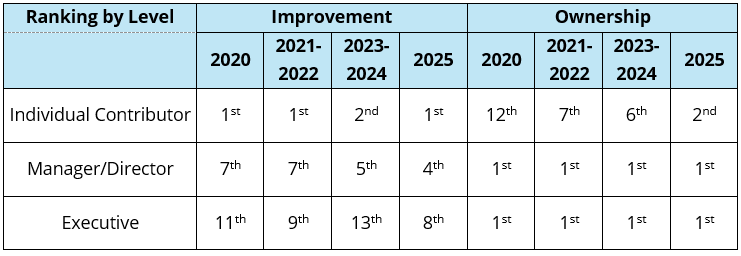
(Percentile Rankings out of 40 total QVL behaviors)
Why the Shift Makes Sense
Individual Contributors
Growth is the currency. Early career value is created by building new skills and applying them to solve problems. An emphasis on Improvement propels Individual Contributors to seek feedback, add tools, and experiment. In an AI-accelerated skills market, this orientation is increasingly non-negotiable.
Example: Avery scores in the top decile on Improvement and median on Ownership. Avery proactively learns new tools and asks for stretch projects, yet sometimes delays completing tasks to ensure everything is perfect. Coaching focus is set-up time-bound experiments and delivery commitments to convert learning into results.
Managers and Executives
Accountability is the standard. Once you lead others, outcomes matter more than personal mastery. Ownership signals willingness to make decisions, set standards, and be answerable for results in uncertainty. Organizations that strengthen accountability at these levels execute better and sustain healthier cultures.
Example: Jordan exhibits top decile Ownership and median Improvement. Jordan drives deadlines and holds the team accountable, but resists adopting new analytics and collaboration tools. Coaching focus is to develop explicit learning goals and peer-led adoption sprints to keep growth current while sustaining accountability.
The organization design implication is that leaders at each level still need a mix of both motivations, but the primary driver changes with the job. Role-fit improves when we balance Improvement and Ownership in the proportions the role demands.
The Goldilocks Rule: Productive Discomfort Without Burnout
Finding the right level of challenge has always mattered for leadership development, but it matters even more in an environment where AI is accelerating work cycles, roles are expanding, and expectations shift faster than most people can recalibrate. The Goldilocks Rule (not too much challenge and not too little) is easy to understand but difficult to achieve and even harder to maintain.
From a research perspective, this optimal zone sits at the intersection of three well‑established principles:
- The Yerkes-Dodson Law shows that performance increases with stress up to a point, after which overload leads to decline
- Bjork’s Desirable Difficulties theory shows that appropriately hard tasks deepen learning and build long‑term capability
- Cognitive Load Theory highlights how excessive complexity drains working memory and compresses problem‑solving capacity
This means leaders grow the fastest when they are asked to do something just outside their current capability, but with enough scaffolding to stay in control of the learning. Too little challenge and they stagnate. Too much and they withdraw, avoid, or burn out.
Where Leaders Typically Miss the Mark
Managers often find themselves oscillating between extremes. On some days, their attention is swallowed by urgent work (e.g., putting out fires, cross‑functional escalations, team tension, or shifting priorities). On other days, they are so overloaded by meetings that meaningful strategic thinking disappears altogether. Both conditions erode growth.
Under-challenge often shows up when leaders become overly comfortable. Work feels familiar. They can predict outcomes. Improvement stops being necessary, because the environment no longer demands it.
Over-challenge emerges when expectations rise faster than authority, context, or clarity. Leaders feel pressure to deliver but don’t feel equipped to succeed. Stress feels chronic rather than energizing.
A healthy growth environment sits in between where there are challenges, expectations are clear, and support is present.
Practical Indicators of the “Optimal Zone”
Leaders can gauge whether the team is in the optimal learning zone by looking for a few signals:
- Curiosity and experimentation (healthy zone) vs. avoidance or disengagement (overload)
- Timely progress on new behaviors vs. repeated delays or procrastination
- Energy after stretch activities vs. emotional depletion or irritability
- Proactive problem-solving vs. excessive checking-in or dependency
- Willingness to share mistakes vs. hiding errors or becoming overly self-critical
These clues give managers a reliable way to course‑correct in real time.
How to Engineer Productive Discomfort Without Overload
This is where organizational design plays a decisive role. Leaders can help their teams stay in the optimal zone by intentionally shaping the conditions in which they work.
- Clear decision rights: People can take healthy risks only when they know what they own. When authority is ambiguous, stretching can feel dangerous and stressful. Apply the RASCI tool and focus on role clarity.
- Learning sprints: Short, time-boxed cycles help leaders test new behaviors without creating open‑ended pressure. Build experiments, mini-assignments, and quarterly priorities.
- Protected thinking time: Without space to reflect, stretch becomes strain. Even one hour a week signals that learning is part of the job. Align on role clarity for productive time and protect it.
- Context-first communication: Teams and especially middle managers perform better when they understand the “why” behind a change, not just the “what.” Ensure the vision and immediate path is clear while emphasizing the path will change so flexibility is essential.
- De-risked failure: When leaders model selective unlearning and visible course corrections, they normalize smart risk-taking across the system. Change is inevitable, but the way the team navigates the change needs to be understood.
Examples of Productive Discomfort in Action
A new manager receives authority to redesign a workflow but is paired with a mentor to think through decision trade-offs. Stretch + support = growth.
An experienced director is asked to adopt a new collaboration or reporting platform. Instead of mandating proficiency, the leader frames it as a 30-day experiment with clear success criteria. Challenge becomes curiosity, not fear.
An executive leads a major shift in strategic priorities. Rather than pushing a top-down message, they co-create a transition plan in a collaborative, cross-functional workshop which distributes the cognitive load and accelerates the buy‑in.
Productive discomfort grows both capability and confidence which are the two ingredients that become especially valuable when reinvention is constant and expectations are rising.
A Practical Playbook for Each Level
For Individual Contributors
- Quarterly stretch assignments are one of the most effective ways to help individual contributors stay aligned with the pace of modern work. When the stretch is tied to a concrete business priority (e.g., a new client deliverable, a process improvement, or the adoption of a new tool), people experience firsthand how their learning translates into value. Treating these experiments as deliverables, with due dates and check‑ins, helps Individual Contributors avoid the trap of “learning without application.” A common example is when someone spends weeks researching a new methodology but never pilots it. The goal is quick cycles, visible progress, and small wins that build momentum.
- Regular demonstrations, even informal ones, reinforce this mindset. When people know they will share progress every two to four weeks, they stay focused on real outcomes instead of theoretical knowledge. It also prevents perfectionism from slowing down the work. For example, an employee learning a new analytics platform might present a rough draft of a dashboard rather than waiting until everything is polished. The point is forward motion, not flawlessness. It can be good and enough to move forward. This habit should keep Improvement high while reinforcing accountability, the essential motivator they’ll need as they move up.
For Managers and Directors
- Managers thrive when authority and accountability match. Codifying decision rights gives them the psychological permission to act decisively, rather than feeling stuck between senior leadership and their own teams. This doesn’t require pages of documentation, even a simple conversation defining what the manager owns, what they influence, and where they must collaborate can dramatically increase clarity. When managers know their lane, they spend less time seeking approval and more time leading. Conversations are essential, but managers may also need a RASCI and role clarity document for support and reference material.
- Balancing the scorecard is equally important. When managers are evaluated only on delivery, learning naturally gets deprioritized. Adding two explicit learning indicators, such as adoption of a new AI-driven workflow or successful cross-functional collaboration, signals that growth is part of the job, not an extracurricular activity. A useful example is that a director responsible for operational metrics might also track how effectively their team designs and uses a new scheduling system, or how well they lead quarterly process-improvement cycles or product innovation sprints. These integrated measures keep Ownership high while ensuring Improvement remains active and relevant.
For Executives
- Executives operate in environments defined by uncertainty, so pairing accountability with adaptation becomes essential. Setting outcome targets is necessary, but equally valuable is establishing a monthly rhythm where senior teams step back and review what has changed and what they have learned. These sessions shift the culture from “inspect results” to “inspect learning,” which strengthens long-range decision-making. For example, after launching a new product, an executive team might spend time exploring unexpected customer behaviors or emergent AI capabilities rather than reviewing only revenue trends.
- Selective unlearning is a powerful but often overlooked part of executive leadership. When executives model the willingness to drop a once-important priority because a better path has emerged, they give the organization permission to adapt with less fear. This is especially important during reinvention cycles. Imagine a senior leader who championed a legacy initiative but now sees the data pointing elsewhere. Publicly pivoting and explaining why signals that Ownership includes making bold choices in service of the future, not defending the past. This clarity accelerates alignment and reduces friction across levels.
Summary
This is an era when AI and workflow automation are rewiring the building blocks of work, and hybrid operating models stretch coordination across distance. For leaders to thrive, they need to pair the right motivation for their level with the right dose of productive challenge. For Individual Contributors, keep Improvement front‑and‑center to build skills at market speed. For Managers and Executives, anchor on Ownership to sustain clear decisions and accountable outcomes. Design roles and routines that hold leaders in the optimal stress zone where they are stretched enough to grow while supported enough to avoid burnout. Verify progress with behavior‑level data rather than assumptions. Get this right and you close today’s leadership gap while accelerating reinvention itself. Faster learning, steadier execution, and bolder agenda‑setting across the organization.